 shinbo
Shinbo Free Router: model fallback and limits
Shinbo can try an ordered list of free OpenRouter models when one is unavailable. Provider availability and limits still apply.
These guides describe the current development source. The published v0.7.1 release can differ; check release notes before following a workflow.
An ordered model chain with fallback.
A router is a named, ordered chain of models. Shinbo ships one: the Shinbo Free Router, ten :free OpenRouter ids. When the first link is rate-limited, down or retired, the next one is tried. A request can still fail when no eligible model is available, and the catalog in your app decides which ids are live.
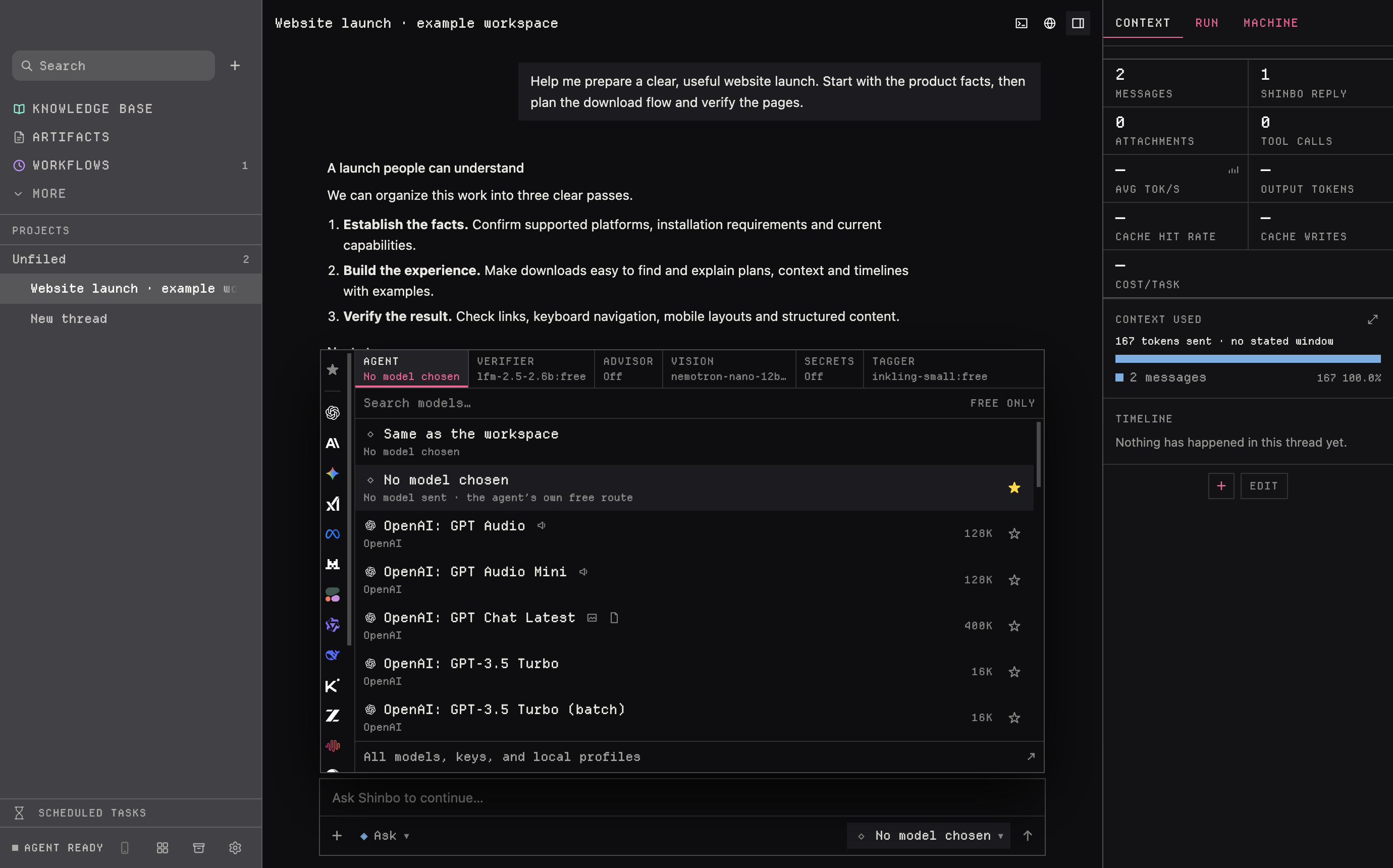
- In the composer picker, choose Shinbo Free Router. It sits above the catalog and carries a Free badge.
- Send a prompt. The transcript footer names the model that actually ran.
- To change the order, open Settings → Models → Catalog & routers, drag links, ✕ one to drop it, or add a zero-priced model.
- Click Add a router to start a second chain; it is seeded with the free one.
 nvidia/nemotron-3-ultra-550b-a55b:free
 thinkingmachines/inkling:free
 z-ai/glm-5.2:free
 poolside/laguna-s-2.1:free
- nvidia/nemotron-3-super-120b-a12b:free
- thinkingmachines/inkling-small:free
- Ddots-studio/dots-3-note-preview:free
- poolside/laguna-xs-2.1:free
 cohere/north-mini-code:free
- nvidia/nemotron-3.5-lightning:free
- Sent per request
- first three eligible links
- Links 4–10
- ranked reserve
- Routers
- up to 5
- Links per router
- up to 24
- Add a link
- any model priced at zero
- Context window
- the first link's
A router whose ids are all :free shows the Free badge. Edits are validated in the renderer and again in the main process.
How fallback works.
Shinbo expands a router into OpenRouter's fallback array: a list of models sent with one request. OpenRouter rejects more than three, so each request carries only the first three surviving links. Links 4–10 are not ten tries in one request; they are the reserve that moves up when an earlier id retires.
Before a request, every chain is filtered against the model catalog the app actually has. A retired id is dropped, not sent. If the catalog is empty, on first launch or with no network, the chain goes unfiltered so it still routes.
The reply's model id is recorded per turn. The transcript footer names it, and draws a Fell back to … notice when the answering model changes mid-turn. A :free variant answering for its base model does not count as a fallback.
A minute with no output and no tool call (three minutes if a tool is running) draws a stall notice with Try another model. Picking one swaps this turn: the run stops and the same prompt requeues on the model you chose.
Cost and keys.
Shinbo has no paid tier, license key or account. Running on the free chain can cost nothing. It does not include unlimited inference: free routes depend on provider availability and limits, and a fallback can fail too. Shinbo documents no numeric rate limit.
The chain still needs the verified OpenRouter key from first launch; a free-tier key passes. How keys are stored, and the other providers, subscriptions and local endpoints you can route to, are on Models.
An OpenRouter setting for the main agent loop only. It restarts the local harness and asks OpenRouter for endpoints with no data collection and zero retention on every request. It fails closed: a model with no qualifying endpoint fails, and never falls back. It does not cover verifier, vision, advisor, secrets or tagger calls, tools, or your OpenRouter account's own logging settings.
- Three links per request. A router longer than three is a reserve, not extra retries.
- A free route is only as available as its provider. Expect rate-limit fallbacks at busy hours; the footer tells you when.
- A free or paid badge says nothing about an endpoint's data policy. Use Private routing if that matters, and accept that it can fail.
- OpenRouter variants (
:free,:batch,:nitro,:online) stay on OpenRouter and offer no direct-provider switch.
Related: Models for roles, providers and subscriptions · Control for the verifier model behind Auto mode · Harness for running other CLIs on their own sign-ins.